If you need to store things under the bed and make the most of every centimetre of your bedroom, an ottoman bed is the one for you. If you want a low, well-ventilated bed with a light visual presence and you don't need storage, a tatami bed is the better fit. It's not really a matter of taste: it comes down to how much floor space you have and what you want the bed to do for you.
Both options are in our collection of solid wood beds, tatamis and storage beds. Before you choose, check which mattress size you need with our guide to bed sizes.
In short:
- A tatami bed stands 16 to 18 cm high; an ottoman bed is around 32-33 cm.
- An ottoman bed takes up exactly the size of your mattress. A tatami adds a surrounding frame: up to 41 cm extra in width.
- Only a lift-up ottoman bed gives you storage inside. A tatami stores nothing.
- A tatami ventilates the mattress through its slatted base; with an ottoman bed it's a good idea to air out the inside every few months.

The low height of a tatami keeps sightlines clear and makes the room feel larger.
What a tatami bed is and who it suits
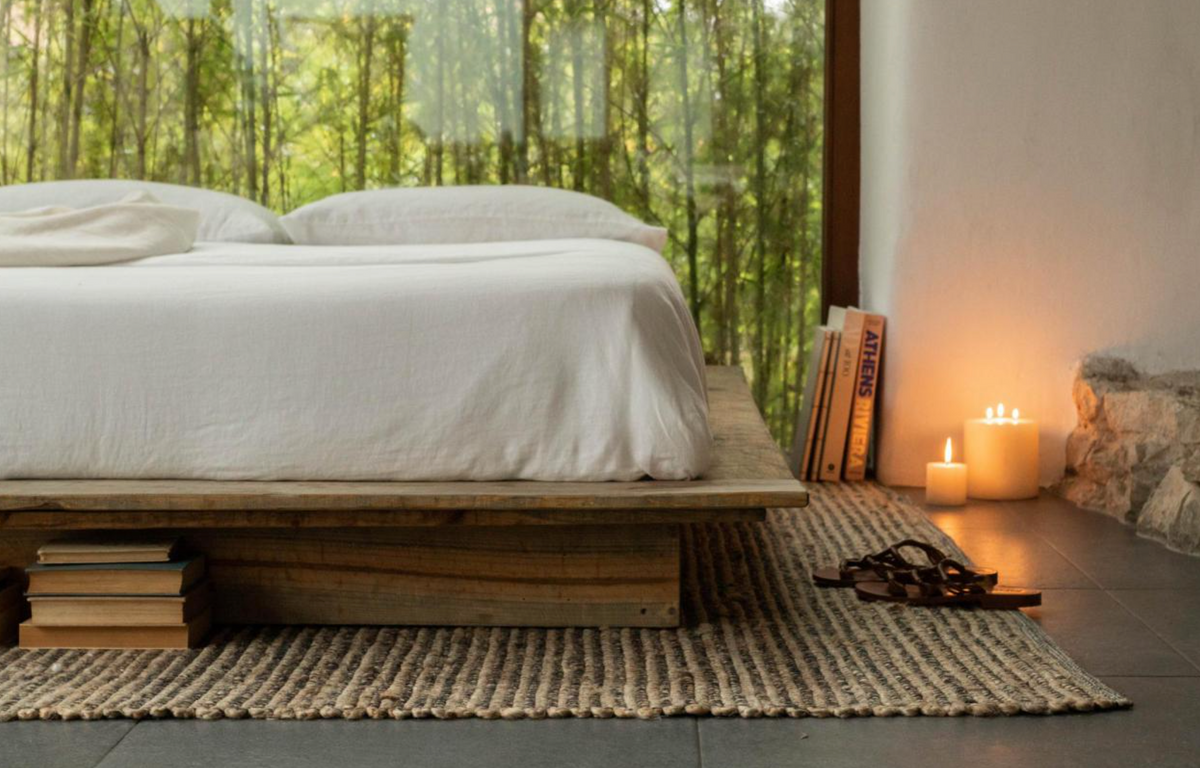
A tatami is a low bed with a solid frame and no tall legs, inspired by the Japanese tradition of sleeping close to the floor. The mattress rests directly on a slatted base or on the frame itself, without an additional bed base. Its total height is around 16-18 cm, compared with the thirty-odd centimetres of a conventional bed.
That difference in height changes how the room feels. With the top of the mattress sitting lower, the free wall above it takes centre stage and the ceiling looks higher. In attic bedrooms or rooms with low ceilings, it's often the only way to stop the bed from overwhelming the space.
What you need to be clear about is that a tatami doesn't take up the size of the mattress, but quite a bit more. The surrounding frame that gives it its character is also what eats into the floor. With the Anhelí double tatami, a 135 x 190 cm mattress translates into a frame 176 cm wide by 211 cm long: 41 cm wider and 21 cm longer than your mattress. With the Sira double tatami, the same mattress gives 168 x 207 cm, a little more compact.

Anhelí double tatami

Sira double tatami
What an ottoman bed is and who it suits
An ottoman bed is a closed bed base that takes up exactly the surface of the mattress, usually 32-33 cm high. In its lift-up version, the top rises to reveal the entire space inside, which is the largest amount of storage you can get in a bedroom without adding a single piece of furniture.
Here lies its decisive advantage: it doesn't steal a single centimetre of walking space. The Deldel double storage bed, in solid fir wood, measures 135 cm wide by 190 cm long for a 135 x 190 mattress. Not one centimetre more. In a bedroom where the bed fits between two walls, or where there's 60 cm of clearance on each side, that difference from a tatami is what decides the purchase.
The Dune upholstered ottoman bed has a lift-up frame giving access to that space inside, stands 32 cm high and is upholstered in natural fabric. It's the option for when storage isn't an extra but the very reason for buying.

Deldel double storage bed

Dune upholstered ottoman bed
Tatami or ottoman bed: the differences that matter
| Criterion |
Tatami bed |
Ottoman bed |
| Frame height |
16-18 cm |
32-33 cm |
| Floor space taken up |
Up to 41 cm wider than the mattress |
Exactly the size of the mattress |
| Storage inside |
None |
The whole space under the mattress, in lift-up versions |
| Mattress ventilation |
Continuous, through the slatted base |
Best opened and aired every few months |
| Getting up in the morning |
More demanding: the surface sits low |
Comfortable height for most adults |
| Materials in our range |
Solid pine and reclaimed wood |
Solid fir or upholstered in natural fabric |
| Headboard |
Optional, built into some models |
Paired with a separate headboard |
When to choose a tatami
- Your bedroom has a low ceiling or is in the attic and you need to lower the visual line of the bed.
- You have enough room around it: the surrounding frame needs space that isn't always there.
- You care about mattress ventilation, because you live in a damp area or your mattress is memory foam.
- You're looking for a statement piece that works as the main feature of the bedroom without needing more furniture.
- Storage under the bed isn't part of your plans: you handle it with a wardrobe or chest of drawers.
When to choose an ottoman bed
-
You need to store things and your wardrobe has run out of room: seasonal clothes, suitcases, duvets.
- The bedroom is small and every centimetre of walking space counts.
- The bed fits between walls or into an alcove of exact size.
- You prefer a comfortable height for sitting down and getting up, or there's an older person at home.
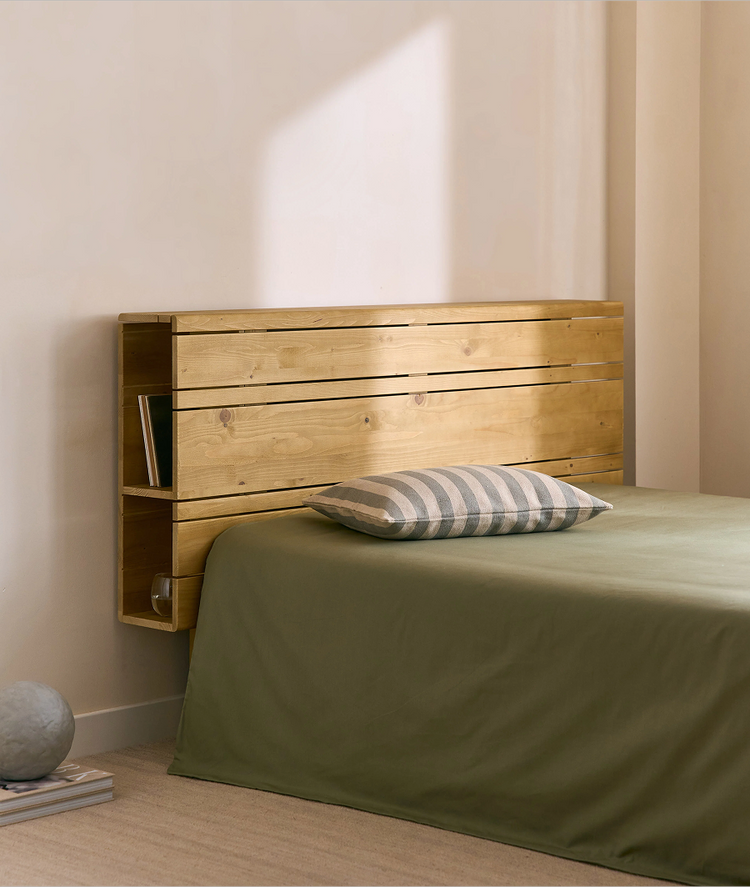
- You want to choose the headboard separately and change it later without touching the base: you'll find plenty of options among our headboards.
Common mistakes when choosing between a tatami and an ottoman bed
The most common is measuring the room with the mattress in mind rather than the frame. With an ottoman bed it doesn't matter, because they're the same. With a tatami it does: if you have a 150 cm space and buy a tatami for a 135 mattress, it may not fit. Always measure the frame, not the mattress.
The second is buying a lift-up ottoman bed without checking the opening. The top needs clear room to lift above it, and a poorly chosen headboard or a low shelving unit can block it.
The third is assuming a tatami is cheaper because it's simpler. It isn't necessarily: it depends on the wood and the workshop craftsmanship, not on the height.
And the fourth, very common in shared bedrooms: forgetting that on a tatami you sleep closer to the floor, and you'll notice it when you get up. If you have knee or back trouble, try one before deciding.
Frequently asked questions
Can you put a normal mattress on a tatami?
Yes. Tatamis with a wooden frame take any standard-size mattress. What changes compared with a conventional bed base is that the base is rigid and ventilated, so it's best to use a mattress that doesn't require a specific slatted base. Check your mattress manufacturer's recommendations.
How much extra space does a tatami need compared with the mattress?
It depends on the model. In our range, the difference is 33 to 41 cm in width and 17 to 21 cm in length compared with the mattress size. Before buying, add that extra room to your bedroom measurements and check there's still space to walk around.
Do all wooden ottoman beds lift up?
No. Some storage beds are a closed base with no opening, while others have a lift-up frame with access to the inside. If you're buying for storage, check on the product page that the model lifts up: it's a specific feature, not something that comes as standard.
Does a mattress get less ventilation on an ottoman bed?
The mattress sits on a closed base, so air circulates less than on a slatted tatami. It's not a problem if you air it: open the top for a while every two or three months and turn the mattress as its manufacturer advises.
Which is better in a small bedroom?
The ottoman bed, almost always. It takes up only the surface of the mattress and also provides storage that would otherwise need an extra piece of furniture. A tatami looks its best in rooms with plenty of floor space.
Whichever you choose, the decision rests on two measurements: the space the frame takes up and what you need to store. If you're already clear, in our collection of beds, tatamis and storage beds you'll find both options in solid wood, made in European workshops.


 and how does it work?



Igor storage headboard
Integrated bookshelf, beds 90, 135, 150, and 180 cm179,90 €Sale price From 159,90 €Deldel Storage Bed
Solid pine wood. For beds of 135, 150, and 180 cm949,00 €Sale price From 899,00 €Kora dining table
160 / 180 / 200 cm899,00 €Sale price From 799,00 €Marnie Headboard
Natural raffia mesh, beds 90, 135, 150, and 180 cm149,90 €Sale price From 129,90 €Luna Sofa Bed
Sofa bed made of natural linen and cotton fabric / 247 cm1.199,00 €Sale price 1.099,00 €Tatami Bed Ren
140 / 150 / 160 / 180 cm949,00 €Sale price From 849,00 €Queralt shelf
Irregular edge front. 60 or 120 cm long67,99 €Sale price From 59,99 €Nia Chair
Solid teak wood and rope239,90 €Sale price 209,90 €Aloma modular shelving
Sustainable pine wood. 4 movable shelves219,90 €Sale price 179,90 €Lira dresser
Solid teak wood and rope, four drawers899,00 €Sale price 829,00 €Neo sideboard
Solid teak wood1.299,00 €Sale price 1.149,00 €Nala Headboard
Solid wood, beds 90, 135, 150, and 180 cm119,90 €Sale price From 109,90 €Tosca Extendable Dining Table
120 cm · Extends to 160 cm899,00 €Sale price 799,00 €TV Stand Ciro
Solid teak wood849,00 €Sale price 749,00 €Headboard with storage Cédric
Solid pine wood headboard 100 cm / 145 cm / 160 cm / 190 cm249,90 €Sale price From 219,90 €Biel Desk
118 cm499,90 €Sale price 449,00 €Ilor TV Unit
Oak and rattan699,00 €Sale price 649,00 €Sile Bookcase
128 cm599,00 €Sale price 549,00 €Teva Sideboard
Oak and rattan999,00 €Sale price 899,00 €Palmira lift-up coffee table
Pine wood with rounded corners. 100 x 42 x 70 cm349,90 €Sale price 299,90 €Codos Desk
100 cm369,90 €Sale price 319,90 €Dune upholstered storage bed
140 /160 / 180 cm899,00 €Sale price From 809,00 €Kivo Bookcase
128 cm399,90 €Sale price 349,90 €Elia Bed
160 cm1.199,00 €Sale price 1.099,00 €Margot Extendable Dining Table
180 cm · Extendable to 220 cm1.099,00 €Sale price 999,00 €Carole bedside table
Solid pine wood bedside table 41.5 x 50 x 31.5159,90 €Sale price 139,90 €Maru hallway bench / shoe cabinet
Solid teak wood649,00 €Sale price 549,00 €Marnie chest of drawers (4 drawers)
With natural raffia mesh. 86 x 92 x 44 cm809,00 €Sale price 649,00 €Ateca Desk
128 cm349,90 €Sale price 299,90 €Upholstered chair Sena
Solid beech wood229,90 €Sale price 209,90 €Marnie Bedside Table
35 x 50 cm149,90 €Sale price 129,90 €Maia Dining Table
140/160/180/200/220 cm599,00 €Sale price From 499,90 €Tera TV stand
Solid teak wood749,00 €Sale price 649,00 €Rayons headboard
Solid pine wood headboard 100 cm / 145 cm / 160 cm / 190 cm189,90 €Sale price From 159,90 €Arnau chaise longue sofa
3-seater with chaise lounge in recycled polyester fabric 240 cm / 260 cm1.649,00 €Sale price From 1.449,00 €Anhelí Double Tatami
Reclaimed pine wood. For beds of 135, 150, and 180 cm879,00 €Sale price From 699,00 €Dining table Dina
140 / 160 / 180 / 200 / 220 cm899,00 €Sale price From 779,00 €Raizo TV unit
Solid teak wood799,00 €Sale price 699,00 €Nest upholstered headboard
140 /160 / 180 cm299,90 €Sale price From 279,90 €Clay upholstered headboard
140 /160 / 180 cm229,90 €Sale price From 209,90 €Odelia Dining Table
140/160/180/200/220 cm719,00 €Sale price From 609,00 €Kael sideboard
Solid teak wood599,00 €Sale price 499,90 €Numa dining table
160 / 180 / 200 / 220 cm689,00 €Sale price From 549,00 €Dera Bed
140 / 160 / 180 cm899,00 €Sale price From 799,00 €Dena Mirror
90 / 150 cm199,90 €Sale price From 169,90 €Chair Sena
Solid beech wood219,90 €Sale price 199,90 €Nodo Modular Shelf
50 x 27 x 36 cm67,99 €Sale price 59,99 €Haydé shoe rack sideboard
Doors with rattan mesh. 80, 100, or 120 cm479,90 €Sale price From 429,90 €Bobbie floating bedside table
40 cm44,99 €Sale price 37,99 €Carole two-drawer bedside table
Solid pine wood bedside table 41.5 x 50 x 31.5199,90 €Sale price 159,90 €