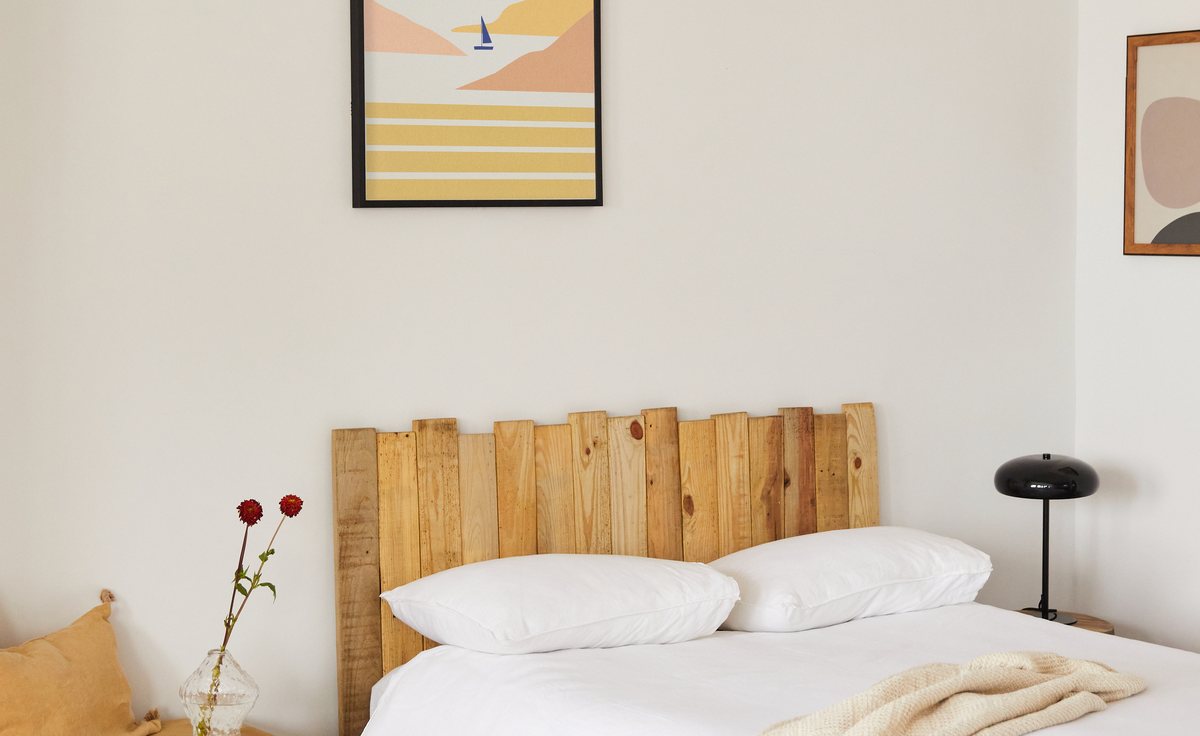
The wall above the headboard is the most visible space in the bedroom and the one most often left bare. Before deciding what to hang there, two things matter more than taste: how far the piece sticks out from the wall and how high it goes. That determines whether the result looks good and, above all, whether anyone bumps their head when getting up.
In short:
- Leave 60 to 90 cm clear if the piece has depth or sticks out, like a shelf.
- If it's flat, like a print or a wall decal, 15 to 25 cm above the headboard is enough.
- The arrangement looks balanced if it covers around two thirds of the width of the bed.
- This idea works best with simple headboards. If yours already makes a statement, it's better to leave the wall bare.

An arrangement works when it reads as a whole, not as loose objects scattered across the wall.
Before you hang anything: check your headboard
Decorating this wall only makes sense if your headboard is simple, or if you don't have a headboard at all. If you already have a tall piece, one with relief or a fibre panel that draws attention on its own, adding something above it overloads the look and takes away rather than adds.
The quick test: stand in front of the bed and look at the wall. If the first thing you see is the headboard, it already has enough presence.
The measurements you shouldn't skip
This is the part people improvise most and the one that causes the most problems later. They aren't rigid rules, but they are the starting point any interior designer uses before adjusting to the specific case.
| What you measure |
Guideline |
Why |
| Clear space above the headboard, pieces with depth |
60-90 cm |
Avoid bumping your head when sitting up in bed |
| Clear space, flat pieces |
15-25 cm |
So they read as a whole with the headboard |
| Width of the arrangement |
Two thirds of the width of the bed |
Proportion: neither lost nor overflowing |
| Maximum depth of a shelf above the bed |
20 cm |
The more it sticks out, the more it gets in the way |
| Spacing between pieces in an arrangement |
5-10 cm |
Any more spacing and the arrangement falls apart |
For a 150 cm bed, for example, the arrangement should be around 100 cm wide in total. That can be one large piece or three small ones, spacing included.
How to decide what to put up
Centred or off-centre?
Centring creates a clear focal point and is the safest choice when the piece is large or very eye-catching. Placing it off-centre gives a more dynamic result and works well when a bedside table on one side naturally unbalances the arrangement. There's no right answer: what doesn't work is going halfway, slightly off-centre without meaning to be.
One large piece or several small ones?
A single standout piece is the safest option and the most advisable in small rooms, where several pieces quickly feel cluttered. Several small pieces call for more judgement: they need to share something —theme, palette, type of frame— so they read as a group and not as a mess.
Colours and materials
Two opposite strategies rule here, and both work. The first is contrast: a piece in a strong colour on a neutral wall, which becomes the focal point of the bedroom. The second is integration: tones close to those of the wall and the furniture, with texture providing the interest instead of colour. What rarely works is the middle ground, an in-between colour that neither stands out nor blends in.
Option by option
Prints and pictures
This is the most straightforward solution and the easiest to change when you get tired of it. As they're flat, they can go relatively close to the headboard, between 15 and 25 cm. If you go for an arrangement, first define the overall rectangle you want to fill and lay out the pieces within it.

Willow Bough Pattern print
If you prefer your own photograph, a wooden frame with a bit of thickness stands the test of time better than a thin metal one, and suits a bedroom with wooden furniture better.
Wooden shelves
They make use of vertical space, which is exactly what a small room lacks, and let you change what's on them without drilling a new hole each time. In return, they're the option that needs the most care: they're the ones that stick out, which is why they need 60 to 90 cm of clear space.
Two things before you drill: check that the fixings suit your type of wall, and don't load the shelf with anything heavy if it's directly above where you sleep.

Queralt set of 2 shelves
Small wall pieces
A wall vase, a clock, a ceramic piece. They take up little room, barely stick out and are the simplest way to add something without committing to a large arrangement. They work especially well in twos or threes, evenly spaced.

Koen wall flower vase
Mirrors
They add depth and bounce light back onto a wall that's usually in shadow. For this particular spot, a landscape format works better than a portrait one, because it follows the line of the bed instead of fighting it.
A safety warning comes before any decorating advice: a mirror above the bed must be securely anchored and as light as possible. If you have any doubts about the wall or the weight, put it to the side.

Mairu mirror
Wallpaper and wall decals
It's the most affordable way to completely change the look of the wall, and the only one that doesn't require drilling. Self-adhesive wallpaper goes up without tools and comes off without leaving a mark on most surfaces, which makes it the obvious choice if you rent.
Two tips: keep the wallpaper to the headboard wall rather than running it round the whole room, and check beforehand that the wall is smooth, because any bumps or textured finish will show through.
Three mistakes to avoid
-
Hanging something heavy right above where you sleep. This is the most serious mistake. If the piece is heavy, it goes to the side or not at all.
-
Hanging it too high. A piece placed too high becomes disconnected from the headboard and the wall looks split in two.
-
Filling the wall when the headboard already makes a statement. Two focal points on the same wall is one too many.
Frequently asked questions
How high should you hang a picture above the headboard?
Between 15 and 25 cm above the top edge of the headboard if the piece is flat. With more space, the picture and the bed stop reading as a whole. If the piece sticks out from the wall, like a shelf, the guideline rises to between 60 and 90 cm for safety.
What size should the picture above the bed be?
As a guide, the arrangement should cover about two thirds of the width of the bed. For a 150 cm bed, that's around 100 cm wide in total, whether with one large piece or several small ones plus their spacing.
Is it safe to put a mirror above the bed?
It can be if the mirror is light, the fixings suit the type of wall and it's securely anchored. Even so, if you have any doubts about the weight or the condition of the wall, the advice is to put it to the side of the bed rather than directly above it.
What should I put up if I don't have a headboard?
It's the best scenario for this idea, because the wall is free. A wide arrangement of prints, a panel of shelves or even wallpaper on just that wall all work well, visually doing the job of a headboard without taking up any space.
If you're putting the bedroom together from scratch, it's best to choose the headboard first and then what goes above it, not the other way round.
Keep reading


 and how does it work?



Igor storage headboard
Integrated bookshelf, beds 90, 135, 150, and 180 cm179,90 €Sale price From 159,90 €Deldel Storage Bed
Solid pine wood. For beds of 135, 150, and 180 cm949,00 €Sale price From 899,00 €Kora dining table
160 / 180 / 200 cm899,00 €Sale price From 799,00 €Marnie Headboard
Natural raffia mesh, beds 90, 135, 150, and 180 cm149,90 €Sale price From 129,90 €Luna Sofa Bed
Sofa bed made of natural linen and cotton fabric / 247 cm1.199,00 €Sale price 1.099,00 €Tatami Bed Ren
140 / 150 / 160 / 180 cm949,00 €Sale price From 849,00 €Queralt shelf
Irregular edge front. 60 or 120 cm long67,99 €Sale price From 59,99 €Nia Chair
Solid teak wood and rope239,90 €Sale price 209,90 €Aloma modular shelving
Sustainable pine wood. 4 movable shelves219,90 €Sale price 179,90 €Lira dresser
Solid teak wood and rope, four drawers899,00 €Sale price 829,00 €Neo sideboard
Solid teak wood1.299,00 €Sale price 1.149,00 €Nala Headboard
Solid wood, beds 90, 135, 150, and 180 cm119,90 €Sale price From 109,90 €Tosca Extendable Dining Table
120 cm · Extends to 160 cm899,00 €Sale price 799,00 €TV Stand Ciro
Solid teak wood849,00 €Sale price 749,00 €Headboard with storage Cédric
Solid pine wood headboard 100 cm / 145 cm / 160 cm / 190 cm249,90 €Sale price From 219,90 €Biel Desk
118 cm499,90 €Sale price 449,00 €Ilor TV Unit
Oak and rattan699,00 €Sale price 649,00 €Sile Bookcase
128 cm599,00 €Sale price 549,00 €Teva Sideboard
Oak and rattan999,00 €Sale price 899,00 €Palmira lift-up coffee table
Pine wood with rounded corners. 100 x 42 x 70 cm349,90 €Sale price 299,90 €Codos Desk
100 cm369,90 €Sale price 319,90 €Dune upholstered storage bed
140 /160 / 180 cm899,00 €Sale price From 809,00 €Kivo Bookcase
128 cm399,90 €Sale price 349,90 €Elia Bed
160 cm1.199,00 €Sale price 1.099,00 €Margot Extendable Dining Table
180 cm · Extendable to 220 cm1.099,00 €Sale price 999,00 €Carole bedside table
Solid pine wood bedside table 41.5 x 50 x 31.5159,90 €Sale price 139,90 €Maru hallway bench / shoe cabinet
Solid teak wood649,00 €Sale price 549,00 €Marnie chest of drawers (4 drawers)
With natural raffia mesh. 86 x 92 x 44 cm809,00 €Sale price 649,00 €Ateca Desk
128 cm349,90 €Sale price 299,90 €Upholstered chair Sena
Solid beech wood229,90 €Sale price 209,90 €Marnie Bedside Table
35 x 50 cm149,90 €Sale price 129,90 €Maia Dining Table
140/160/180/200/220 cm599,00 €Sale price From 499,90 €Tera TV stand
Solid teak wood749,00 €Sale price 649,00 €Rayons headboard
Solid pine wood headboard 100 cm / 145 cm / 160 cm / 190 cm189,90 €Sale price From 159,90 €Arnau chaise longue sofa
3-seater with chaise lounge in recycled polyester fabric 240 cm / 260 cm1.649,00 €Sale price From 1.449,00 €Anhelí Double Tatami
Reclaimed pine wood. For beds of 135, 150, and 180 cm879,00 €Sale price From 699,00 €Dining table Dina
140 / 160 / 180 / 200 / 220 cm899,00 €Sale price From 779,00 €Raizo TV unit
Solid teak wood799,00 €Sale price 699,00 €Nest upholstered headboard
140 /160 / 180 cm299,90 €Sale price From 279,90 €Clay upholstered headboard
140 /160 / 180 cm229,90 €Sale price From 209,90 €Odelia Dining Table
140/160/180/200/220 cm719,00 €Sale price From 609,00 €Kael sideboard
Solid teak wood599,00 €Sale price 499,90 €Numa dining table
160 / 180 / 200 / 220 cm689,00 €Sale price From 549,00 €Dera Bed
140 / 160 / 180 cm899,00 €Sale price From 799,00 €Dena Mirror
90 / 150 cm199,90 €Sale price From 169,90 €Chair Sena
Solid beech wood219,90 €Sale price 199,90 €Nodo Modular Shelf
50 x 27 x 36 cm67,99 €Sale price 59,99 €Haydé shoe rack sideboard
Doors with rattan mesh. 80, 100, or 120 cm479,90 €Sale price From 429,90 €Bobbie floating bedside table
40 cm44,99 €Sale price 37,99 €Carole two-drawer bedside table
Solid pine wood bedside table 41.5 x 50 x 31.5199,90 €Sale price 159,90 €